A blog about U.S. immigration matters by Paul Szeto, a former INS attorney and an experienced immigration lawyer. We serve clients in all U.S. states and overseas countries. (All information is not legal advice and is subject to change without prior notice.)

Contact: 732-632-9888, help@szetolaw.com http://www.1visa1.com/

Showing posts with label green card. Show all posts

Tuesday, June 23, 2026

Travel at Your Own Risk: What the Supreme Court's "Parole" Ruling Means for Green Card Holders


For most lawful permanent residents (LPRs), coming back to the U.S. from an international trip is as simple as showing a green card at the airport. But a major 6-3 Supreme Court decision handed down this Tuesday in Blanche v. Lau has fundamentally changed the rules for green card holders facing legal trouble.

The Court ruled that the Department of Homeland Security (DHS) can place returning green card holders on "immigration parole" instead of officially admitting them into the country—based only on pending criminal charges. Such a distinction has significant legal consequences.

The Case: Blanche v. Lau

The dispute centers on Muk Choi Lau, who became a permanent resident in 2007. In 2012, Lau was charged with trademark counterfeiting in New Jersey. While those charges were still pending—meaning he had not been convicted of any crime—he traveled abroad.

When Lau returned to John F. Kennedy International Airport, Customs and Border Protection (CBP) officers saw the pending charges. Instead of admitting him as a returning resident, they "paroled" him into the country for deferred inspection. Later, after Lau pleaded guilty to the state charges, the government used his "paroled" status to fast-track his removal from the country.

The Second Circuit Court of Appeals had previously ruled in Lau's favor, arguing that the government needed "clear and convincing evidence" of a disqualifying crime at the time he crossed the border, not just accusations. On Tuesday, the Supreme Court reversed that decision.

Parole vs. Admission: Why the Distinction Matters

To understand why this ruling is so significant, you have to look at how the Immigration and Nationality Act (INA) treats noncitizens. The law essentially features two different tracks for removing someone from the U.S.:

Admitted Individuals: Individuals who have been admitted legally to the U.S. are subject to more legal protection when the Government wants to remove them from the country. They are subject to grounds of deportability under the INA. They are presumed to have the right to remain in the country unless the Government can prove otherwise. The Government (DHS) must prove deportability by "clear and convincing evidence" that a person is deportable, which is a relatively high bar. To be deported for a crime, the law generally requires a formal, finalized conviction in a court of law. Mere accusations, arrests, or pending charges are usually not enough to trigger deportability.

Paroled Individuals: In contrast, paroled individuals are considered legally outside the country despite their physical presence. The foreign national must prove "clearly and beyond doubt" that they are legally entitled to enter the U.S. and that no grounds of inadmissibility apply to them. The grounds for inadmissibility are vastly broader than those for deportability. A formal conviction is often not required. An immigration officer can declare someone inadmissible simply if the person admits to committing the essential elements of certain crimes (like drug offenses or crimes involving moral turpitude). Furthermore, for drug trafficking, an officer only needs a "reason to believe" the person is involved.

By placing a green card holder on "parole," the government effectively halt their entry. The individual is physically allowed to go home, but legally, they are still standing at the border. If the pending criminal charges later result in a conviction, DHS can seamlessly move to deport them under the harsher "inadmissibility" rules rather than the standard deportation process designed to protect established residents.

The Supreme Court's Ruling

The Court's 6-3 majority sided with the administration, emphasizing an expansive view of executive authority over immigration at the border.

The ruling establishes that border officers do not need clear and convincing proof of a crime at the exact moment a green card holder returns. Suspicion of a crime—such as a pending state charge—is legally sufficient for an immigration officer to deny standard admission and use the parole loophole. The government successfully argued that requiring border agents to definitively prove criminal conduct on the spot, often without full access to local evidence, was an impractical burden.

Warning: Travel at Your Own Risk

This decision is a massive red flag for any lawful permanent resident dealing with the criminal justice system. The legal presumption that a green card guarantees smooth reentry has officially given way to border enforcement discretion.

If you are an LPR with unresolved criminal charges, accusations, or pending court dates, traveling internationally carries severe immigration risks. Leaving the U.S. could result in your being placed you in expedited removal proceedings upon your return.

Always consult an immigration attorney before booking a flight if you have any pending matters in the criminal justice system. When in doubt, stay in the U.S. until your legal matters are completely resolved.

Wednesday, May 21, 2025

How to Prepare for a Marriage-Based Green Card Interview

Open AI Image


The marriage-based green card interview is a significant step in the adjustment of status process for a foreign national seeking to become a permanent resident of the United States. The purpose of this interview is to verify the authenticity of the marriage and ensure that it was not entered into solely for immigration benefits. As such, proper preparation is crucial to presenting a genuine and credible case to the USCIS officer. 

Gathering Required Documents

One of the most important steps in preparing for the marriage-based green card interview is ensuring that all necessary documents are gathered in advance. This includes birth certificates, marriage certificate, divorce judgments, financial support documents, joint documents showing the marital relationship, previous immigration documents, etc.  The parties should check with their attorney to confirm what documents they should bring, as each case is different. Failure to provide required documentation can lead to delays or denials.

Reviewing Your Application

In addition to gathering documentation, it is essential to review the information submitted in your application. The USCIS officer will likely ask questions based on the details provided in the forms, so it’s important that you and your spouse are familiar with the information. Any inconsistencies in your application or answers during the interview may raise suspicions and complicate the process. Therefore, reviewing your application ensures that you are consistent in your responses and that all details are accurate.

Practicing Common Interview Questions

USCIS officers often ask similar questions to confirm the authenticity of the relationship. Common questions include inquiries about how the couple met, who proposed marriage, what the spouse’s daily routine is like, how they celebrate holidays, and other details about their shared life. It’s important to practice answering these questions, but in a natural and spontaneous way. Over-rehearsing can make the answers seem unnatural, and the officer may perceive this as a sign of dishonesty. Instead, focus on sharing genuine details of your relationship.

Being Honest and Relaxed

Honesty is the most important factor when preparing for the interview. Officers are skilled at detecting fraudulent marriages, and any attempt to fabricate answers or hide details will likely be noticed. Therefore, it is crucial to provide truthful and accurate responses. Relax and be yourself during the interview. If you are not sure about an answer, just say so.  Do not make up anything. The USCIS officer is simply doing their job, and they are not looking for perfection but for genuine answers about your relationship.

Dressing Appropriately

While there is no specific dress code for the marriage-based green card interview, it is important to dress neatly and professionally. This reflects positively on you and shows respect for the process. Both spouses should make an effort to appear presentable, as this can leave a good impression on the officer.

Arriving Early and Prepared

Arriving early for the interview is an essential step in preparation. It allows you time to relax, clear security, and gather your thoughts before the interview begins. Being late can create unnecessary stress and may give the impression that you are unorganized. Plan ahead to ensure that you arrive with enough time to spare, taking in account the local traffic conditions.

Interpreter Services

If either spouse is not fluent in English, it is possible to bring an interpreter to assist during the interview. This must be arranged in advance, and the interpreter should be familiar with both the language and the specific terminology used in immigration proceedings.

Being Prepared for Delays or Follow-up Requests

It is important to be prepared for the possibility that the USCIS officer may not make a decision on the spot. Sometimes, additional information may be needed, or the officer may schedule a follow-up interview. If this happens, be patient and provide any requested documents or explanations promptly to avoid further delays in the process.

Special Situations

If the parties have special issues such as unusual immigration history, previous marriages, cultural and religious differences, criminal history, etc., they should pay special attention and prepare accordingly.  They should work with their attorney to make sure that these issues are addressed before the interview.  With adequate preparation, the parties should be able to pass the interview confidently.


(Immigration laws and policies change regularly.  If you have any questions regarding this article, please visit www.1visa1.com to schedule a legal consultation.)  


Tuesday, March 25, 2025

Precautions for Immigrants and Green Card Holders Under Stricter Immigration Policies


Photo: Markus Winkler

By Paul Szeto LLC            

The new Administration has adopted increasingly stringent immigration policies and enforcement practices. Whether you are a new immigrant, a green card holder, or someone in the process of applying for a green card, understanding and following the rules is more important than ever. Even lawful permanent residents (LPRs) face potential risks if they fail to meet certain legal and procedural requirements.  Here are key precautions and steps immigrants should take to protect their status:

Avoid Prolonged Absences from the U.S.

Spending extended periods outside the U.S. (typically more than 6 months) may be seen as abandoning your green card. If you must travel, keep trips under six months when possible. For longer stays, apply for a Reentry Permit as early as possible.  The processing time now is about 14 months.  You should also maintain ties to the U.S. including a residence, employment, bank accounts, and tax filings. 

File Your Taxes Correctly and On Time

Failure to file U.S. tax returns or falsely claiming non-resident status can raise red flags. In general, always file as a U.S. tax resident if you're a green card holder.  You should report world-wide income too.  Avoid claiming tax benefits (like foreign earned income exclusions) that conflict with your residency status.

Avoid Criminal and Immigration Violations

Even minor infractions can have severe immigration consequences. Be especially cautious with DUI or drug offenses, domestic violence, and fraud (e.g., marriage, employment, or benefit fraud).  If you’re charged or arrested, consult both a criminal defense lawyer and an immigration attorney immediately.

Keep Your Immigration Records in Order

Keep copies of your green card, visas, I-94 records, I-20s, and other key immigration documents.  Report address changes to USCIS within 10 days using the Form AR-11). Willful failure to report address change is a ground for deportation.  Renew your green card on time (every 10 years or upon expiration).

Be Cautious on Social Media and Public Statements

Immigration officers may review public social media activity when adjudicating visa, green card, and naturalization applications. Avoid posting political or inflammatory content that may suggest violence or anti-government sentiment.  Also avoid posts that would suggest unauthorized work or conflicting lifestyle claims.

Consider Naturalization If Eligible

Becoming a U.S. citizen provides the strongest protection against removal or deportation. If you’ve had your green card for at least 5 years (or 3 years if married to a U.S. citizen), and meet residency and good moral character requirements, applying for naturalization is a wise step.

Stay Informed and Seek Legal Help When Needed

Immigration policy can shift quickly. Regularly check updates from reliable sources or subscribe to alerts from Immigration Blogs or USCIS. If you're unsure about how a policy may affect you, consult a qualified immigration attorney rather than relying solely on online forums or hearsay, as policies change regularly. 

Conclusion

In a time of increased scrutiny and evolving immigration rules, staying informed and proactive is essential. Green card holders and immigrants alike should protect their legal status by avoiding common pitfalls, maintaining strong ties to the U.S., and seeking citizenship if eligible. The margin for error is smaller than ever, but with preparation and care, you can safeguard your future in the United States.


(Immigration laws and policies change regularly.  If you have any questions regarding this article, please visit www.1visa1.com to schedule a legal consultation.)  


Wednesday, September 18, 2024

Green Card Renewal Extension Valid for 36 Months


USCIS has updated its policy regarding green card renewals.  Starting Sept. 10, 2024, USCIS has automatically extended the validity of a permanent resident's green card to 36 months, upon filing of the Form I-90, Application to Replace Permanent Resident Card.    The extension is reflected in the filing receipt notice, which can be used as temporary proof of lawful permanent resident status for employment, travel and other purposes.


(Immigration laws and policies change regularly.  If you have any questions regarding this article, please visit www.1visa1.com to schedule a legal consultation.)  

Tuesday, August 27, 2024

Federal Court Temporarily Halted PIP Approvals for Spouses and Step-Children of US Citizens


Biden Administration's Parole-in-Place (PIP) or "Keeping Families Together" program became effective on August 19, 2024. However, 16 States, led by Texas, filed a lawsuit to stop the implementation of the program.  On August 26, 2024, a federal judge in Texas issued an order to temporarily stop the program for 14 days, which can be extended. During this time, applicants may still submit PIP applications to USCIS, but USCIS may not grant parole in place.  The following are some additional clarification of the program: 

What are the basic requirements for the PIP program?

The applicant must be physically present in the United States and entered without having been admitted or paroled by immigration officers.  Both spouses of U.S. citizens and stepchildren of U.S. citizens may apply.  Spouse must be continuously present in the U.S. since June 17, 2014. Stepchildren must be continuously present in the U.S. since June 17, 2024. Spouse applicants must have a legally valid marriage to a U.S. citizen as of June 17, 2024.  Stepchildren must have a parent who was legally married to a U.S. citizen by June 17, 2024, and before the child’s 18th birthday. Also, stepchildren must be under the age of 21 as of June 17, 2024.  Applicants must not have a disqualifying criminal history, and must not pose a threat to national security or public safety.

Can an applicant who is in removal proceedings apply for PIP?

Applicants in removal proceedings may apply for PIP under this program if they are otherwise qualified. However, a pending PIP request does not prevent an undocumented applicant from being placed into removal proceedings by CBP or ICE. 

How can an applicant obtain an employment authorization document?

There is no automatic EAD associated with the PIP application.  However, after an applicant's PIP application has been approved, the applicant may apply for an EAD from USCIS based on the C11 category.  

How can an applicant with approved PIP apply for a green card?

Applicants with approved PIP would be considered in a period of authorized stay, which means they may apply for a green card through adjustment of status based on petitions submitted by their family members. However, they must still meet other requirements for adjustment of status.

What happens if a spouse applicant's U.S. citizen spouse passed away?

If the death occurred after June 17, 2024, the applicant will still be eligible.  USCIS allows widows and widowers to apply for parole status.  However, this applicant may or may not be eligible for adjustment of status (green card) later on. 

What happens if a spouse applicant and her U.S. citizen spouse divorce?

To be eligible for PIP, the applicant must be married to a U.S. citizen as of June 17, 2024, and stays married to the U.S. citizen until the time of filing the PIP petition.  

If I am granted PIP parole status as a stepchild of a U.S. citizen, what will happen to me if my parent and U.S. citizen stepparent divorce before I am able to apply to adjust my status (before my parole period ends)?

If your noncitizen parent and U.S. citizen stepparent divorce, you may continue to be eligible as an immigrant petition beneficiary and for adjustment of status if your stepparent demonstrates an ongoing bona fide parent-child relationship to you. This might include evidence that you and your stepparent reside together or that your stepparent provides financial and emotional support for your care.

If I am granted PIP status as a spouse of a U.S. citizen, what will happen to me if my spouse and I divorce before I am able to apply to adjust my status (before my parole period ends)?

Generally, you will be ineligible to adjust status as the spouse of a U.S. citizen if you and your spouse divorce before you apply to adjust status. To be eligible for immigrant petition approval or to adjust status as the spouse of a U.S. citizen, you must still be married to your spouse at the time of application and final adjudication, unless you qualify for exceptions.

In light of the recent lawsuit blocking the PIP program, should I still file an application now?

It is ultimately your decision.  Currently, USCIS is still accepting applications but may not approve them.  The final result of the lawsuit is unclear now.  Generally, applicants have a pending application are entitled to more legal rights than those who do not.  In fact, USCIS has already approved some applicants' parole status who submitted their applications early on before the lawsuit was filed.


(Immigration laws and policies change regularly.  If you have any questions regarding this article, please visit www.1visa1.com to schedule a legal consultation.)  

Thursday, July 18, 2024

Undocumented Spouses of Citizens May Apply for Parole Starting August 19


The Biden Administration has announced that, starting August 19, eligible spouses of U.S. citizens will be able to submit applications to apply for benefits pursuant to the recently announced parole in place (PIP) program.  Initially they will be eligible for three years of employment authorization (EAD).  Within this time period, they may also apply for a green card through adjustment of status

This parole program was anncouned by the Biden Administration earlier in June of this year.  The purpose is to offer an opportunity for long time spouses of U.S. citizens to be able to obtain legal status without having to depart the United States and be seperated from their family.  Under current immigraion regulations, a person who has entered the United States illegally without a formal inspection and admission by an immigration officer is not allowed to be legalized, even though the person has married a U.S. citizen.  These individuals typically must depart the U.S. and apply for an immigrant visa to return.  Due to their previous immigration violations, it is generally very difficult for them to get a visa. They may first apply for visa waivers or other discretionary relief. 

Starting August 19, 2024, this group of spouses of U.S. citizens may begin submitting applications to apply for parole status in the United States.  If approved for parole in place, the non-citizen spouses will then be permitted to apply for lawful permanent residence within the United States through the adjustment of status process. 

Further details for the application process should be announced in a Federal Register notice soon.  To qualify for parole status, an applicant: 

  • Must be present in the United States without admission or parole;
  • Must have a legally valid marriage to a U.S. citizen as of June 17, 2024;
  • Must be continuously present for at least 10 years as of June 17, 2024;
  • Must have no disqualifying criminal history or national security/public safety concerns; and
  • Must otherwise merit favorable discretion by DHS.

It should be noted that certain non-citizen children of this group of spouses may also be eligible for benefits under this parole program.  To qualify, a child must be unmarried, under the age of 21, and have been physically present in the United States without admission or parole and have had a qualifying stepchild relationship with the U.S. citizen, both as of June 17, 2024.  Further, the child must have been under the age of 18 at the time of the marriage that created the stepchild relationship.

Applicants must wait for further instructions before they may submit their applications for parole starting August 19.  However, eligible applicants should start collecting supporting documents as soon as possible to get ready.  These documents include their passports, ID documents, marriage certificates, birth certificates, proof of 10 years of physical presence, federal income tax returns, school records, medical documents, etc.   If they have been arrested for any reasons, they must provide documents regarding the final disposition of the case. 

This program can be described as an "once in a life time opportunity" for hundreds of thousands of applicants to be legalized.  Eligible applicants should take it seriously and make every efforts to submit a legally sufficient application.  If in doubt, they should consult with an experienced immigration attorney for further information. 


(Immigration laws and policies change regularly.  If you have any questions regarding this article, please visit www.1visa1.com to schedule a legal consultation.)  


Tuesday, June 25, 2024

A Prime Opportunity for AI Professionals to Apply for a NIW Green Card


Photo by Cottonbro Studio


Now is an exceptionally favorable time for professionals with backgrounds in artificial intelligence (AI) to apply for a U.S. green card under the EB-2 National Interest Waiver (NIW) category. The convergence of several key factors underscores the urgency and strategic advantage for AI experts to pursue this opportunity.

The Importance of AI Technologies to the U.S.

AI technologies are at the forefront of innovation, driving significant advancements across multiple sectors including healthcare, finance, defense, and transportation. The U.S. recognizes AI as a critical component of its technological leadership and economic competitiveness. AI's capability to solve complex problems, enhance productivity, and foster new industries makes it indispensable. Thus, professionals who specialize in AI are highly valuable, as their expertise directly contributes to the nation's growth and security.

Maturity of AI Technologies

AI has evolved from a nascent field into a mature technology with real-world applications and robust research foundations. The current landscape is marked by sophisticated AI systems that are transforming industries and improving lives. This maturity means that AI professionals bring tangible, impactful skills to the table, making their contributions both immediate and significant. The AI revolution is real.  

Emphasis by the Biden Administration

The Biden Administration has placed a strong emphasis on AI technologies, recognizing their potential to drive innovation and maintain the U.S.'s competitive edge. In October 2023, President Biden issued an executive order focused on ensuring the safe, secure, and trustworthy development of AI technologies. This executive order not only highlights the strategic importance of AI but also signals a commitment to fostering an environment where AI innovation can thrive .

Furthermore, this executive order includes measures designed to attract and retain top global AI talent, making it easier for professionals in the field to navigate the immigration process . This alignment of policy with technological needs underscores the priority given to AI professionals and enhances the appeal of the NIW category.

National Interest Waiver (NIW) Advantage

The NIW category offers a streamlined path to permanent residency for individuals whose work is deemed to be in the national interest of the United States. Given the strategic importance of AI, professionals in this field are well-positioned to argue that their expertise benefits the nation. The NIW allows applicants to bypass the labor certification process, expediting their path to a green card.

Conclusion

With the U.S. government's clear emphasis on AI, the mature state of AI technologies, and the critical importance of these technologies to national interests, AI professionals have a unique and compelling case for applying for a green card through the NIW category. This is a pivotal moment to leverage these favorable conditions and secure a future in the U.S., contributing to one of the most dynamic and impactful fields of our time.


(Immigration laws and policies change regularly.  If you have any questions regarding this article, please visit www.1visa1.com to schedule a legal consultation.)  

Tuesday, April 23, 2024

USCIS Clarifies Schedule A Exceptional ability in Sciences and Art


Many foreign workers have heard about the EB-1A “extraordinary ability alien petition” and the EB-2 “national interest waiver” petition. These are two types of employment-based green card applications that an applicant may file by themselves, without sponsorship by a U.S. employer. Additionally, applicants can submit these two types of petitions directly with the USCIS without first obtaining a labor certification from the Department of Labor.

The purpose of the labor certification is to test the American job market to see if there are able, willing, qualified and available American workers for the position. If such workers exist, the employer must first offer the position to them. Under the employment-based categories, there is a sub-category of positions under Schedule A that is also exempt from the labor certification requirement.

Schedule A Group I pre-certifies job openings for physical therapists and nurses, while Group II pre-certifies positions that require exceptional ability in "sciences and art". Foreign workers may submit their immigrant visa petitions with USCIS directly without first obtaining a labor certification. However, they must have a full-time offer of employment by a U.S. employer, and also demonstrate exceptional ability in sciences and art.

USCIS recently clarifies that “science or art” means any field of knowledge or skill which colleges and universities commonly offer specialized courses leading to a degree in the knowledge or skill. This definition is adapted from existing DOL regulations. With this definition, most professional and skilled occupations would qualify.

To apply under the Schedule A Group II sub-category, the employer must provide notice of the opening to bargaining representatives, or to its employees. To prove exceptional ability, there must be evidence that the employee's achievements have enjoyed “widespread acclaim” and “international recognition”. The employee must provide evidence to satisfy at least 2 of these 7 criteria:

  1. Receipt of internationally recognized awards;
  2. Membership in international associations that require outstanding achievement;
  3. Published material in professional publications about the employee or his work;
  4. Participation as a judge, reviewer, or juror of the work of others;
  5. Original scientific or scholarly research contributions of major significance in the field;
  6. Authorship of published scientific or scholarly articles in international or professional journals; and
  7. Display of the beneficiary’s work, in the field, at artistic exhibitions in more than one country.

Further, there must be evidence that the beneficiary’s employment during the past year, and also the position offered in the U.S., must also require exceptional ability.

For workers with exceptional or unusual ability that do not meet the requirements of EB-1A and NIW petitions, Schedule A Group II offers an alternative avenue for them to apply for U.S. green cards without going through the lengthy labor certification process.

(Immigration laws and policies change regularly.  If you have any questions regarding this article, please visit www.1visa1.com to schedule a legal consultation.)  


Wednesday, March 27, 2024

Green card for Overseas Foreign Employees of U.S. Government


If you are a long-time foreign national employees of the U.S. Government abroad, there is a new way for you to apply for a U.S. green card.  A new law provides immigrant visas to certain overseas foreign national employees of the U.S. government, their family members, and their surviving spouses and children. 

Section 5104 of the National Defense Authorization Act (NDAA) for Fiscal Year 2024 addresses the immigration needs of certain foreign national employees of the U.S. government stationed overseas. It acknowledges their invaluable contributions and seeks to facilitate their integration into American society. 

This new law allocates up to 3,500 immigrant visas in FY 2024, and up to 3,000 immigrant visas in subsequent fiscal years, to qualifying employees of the U.S. Government abroad and their spouses and children, and the surviving spouses and children of certain deceased employees.  One requirement is that visa numbers are not otherwise available to these overseas employees under the Employment-Based Fourth (EB-4) preference category, which also allocates special immigrant visas for these employees.

Further, to qualify for these special immigrant visas, the foreign employees must have been employed by the U.S. Government abroad for at least 15 years. Further, the U.S. Department of State must have found that it is in the national interest to grant them visas.  Factors to consider include their length of Service,  their commitment and contribution to the U.S. interests, nature of employment, and whether they have been honorably discharged, etc.  

Family members, including their spouses and children, are also eligible for these special immigrant visas.  If an employee sacrificed their lives in the line of duty, their surviving family members are also eligible for these benefits. 

These special immigrants will be admitted via special GV visa codes, or GS in the case of surviving spouses and children.   Upon admission, these special immigrants are lawful permanent residents of the U.S.  As green card holders, they enjoy the regular benefits and privileges of U.S. permanent residents.  They are allowed to reside and legally work in the U.S. indefinitely. They may petition for their eligible family members.  They may also apply for American citizenship through the naturalization process after five years.

Unlike the regular EB visa preference category, allocation of special immigrant visas under NDAA is not subject to the per-country cap or controlled by the EB visa limits.  These special immigrant visas issued each year (up to 3,500 in FY 2024 and up to 3,000 in subsequent years) will be deducted from the number of diversity visas available in the following fiscal year.  

Section 5104 of the NDAA for Fiscal Year 2024 represents a pivotal step towards recognizing and supporting long-time U.S. foreign national employees and their families. By providing a pathway to immigrant visas, the provision acknowledges their invaluable contributions and offers tangible benefits that extend beyond service tenure. 


Monday, January 22, 2024

F & M Students Allowed to file Labor Application and Immigrant Visa Petition


In a recent policy memo issued by USCIS on 12/20/2023, the immigration agency resolved a long-time conflict regarding foreign students' ability to apply for permanent resident status.  Historically, foreign students applying or holding F and M visas were only allowed to study in the United States; they should not harbor other plans such as seeking employment or applying for a green card.  While H-1B and L visa holders are allowed to possess an immigrant intent, F and M students must only have a single intent of studying. Such a discrepancy results in denial of F-1 visa and status to many foreign students.


New Policy Allows Foreign Students to Apply for PR Status

The reality of the situation is that many international students, after earning their degrees and acquiring work experience in the United States, have chosen to stay in the country and become permanent residents. They apply for immigrant status through sponsorship by a family member such as a spouse, or by an employer who offers them permanent employment. To retain these educated students and also to update this archaic single-intent policy, USCIS revised their Policy Manual to confirm international students' ability to apply for permanent resident status without jeopardizing their legal status. 

Specifically, the new policy provides guidance to USCIS officers regarding the adjudication the applications of F and M students and their dependents in the United States for (1) employment authorization, (2) changes of status, (3) extension of stay, and  (4) reinstatement of status.

The policy guidance also confirms that, while foreign students must have a foreign residence that they have no intention of abandoning, they are allowed to be the beneficiary of a permanent labor certification application or immigrant visa petition. The existence of such immigrant petitions does not mean that they cannot demonstrate their intention to depart after a temporary period of stay. 

USCIS recognizes that foreign students are typically younger individuals who do not have strong ties in their home countries, and that they don't necessarily have any long-terms plans regarding their future.  As long as they are able to demonstrate their present intention to depart after their studies, adjudicators should not deny their applications. Such a policy shift is in line with State Department's visa issuance policy and also BIA's case law. 

Simply put, USCIS now distinguishes a foreign student's present intent to study and their longer term plans, which are usually unclear to the student at the present time.  The policy guidance is extremely helpful to foreign students who have opportunities to apply for permanent resident status while they are studying in the United States.  


What about the “mature” applicants? 

One interesting observation is that the policy shift seems to focus on younger students. What about the more mature students who are married and have a family and ties in the United States?  Due to the lengthy green card application process and the per-country visa limits, many foreign students have reached marriage age; they may have already married and started family in the country.  For these mature applicants, they may have to apply for F-1 status again after working for a number of years to update their skills or to maintain their lawful status.  In such cases, it is unclear if USCIS will equally apply this new policy to them. 


Importance of a foreign residence

One thing is clear is that all applicants must provide proof of a foreign residence.  In fact, this is the single underlying requirement for applicants to prove their present non-immigrant intent.  Younger students should be able to meet this requirement by claiming their parent's or family residence in their home country as proof.  For older applicants, it means that they must continue to maintain a foreign residence in order to meet the evidentiary requirement. 


(Immigration laws and policies change regularly.  If you have any questions regarding this article, please visit www.1visa1.com to schedule a legal consultation.)  


Tuesday, September 12, 2023

USCIS Issued Favorable Policy Guidance for EB-1 Extraordinary Ability Petition


Photo by Chris Barbalis on Unsplash

By Paul Szeto, Esq.

On 09/12/023, USCIS updated its Policy Manuel regarding the Employment First Preference EB-1A adjudication standard.  The updates include clarifications of the eligibility and evidentiary requirements for extraordinary ability petitions.  These updates are mostly favorable to the petitioners, especially those in STEM fields.

The current adjudication process of an EB-1A extraordinary ability petition involves two steps.  First, the petitioner must first prove that they have received a one-time achievement (i.e., a major, internationally recognized award) or meet at least three of the ten regulatory criteria.  

Second, the adjudicator must, based on all evidence in the record, make a “final merits determination” to determine if the petitioner has sustained national or international acclaim; and also that their extraordinary ability has been recognized in the field of expertise, indicating that the person has risen to the very top of his profession.  Against this legal framework, USCIS provided the recent update, with the following highlights:

  • Awards from well-known national institutions (e.g., R1 and R2) and professional associations may be accepted as “lesser recognized” awards.
  • Certain doctoral dissertation awards are also acceptable (Such academic awards were discounted by USCIS before.)
  • Certain higher level of professional memberships such as “fellow” are acceptable.
  • Serving as a member of a Ph.D. dissertation committee or peer reviewer for government research funding programs is acceptable evidence (provided, the person must actually serve in these roles.)
  • A high number of citations can be used to prove the significance of a person's original contributions, and a high h-index may serve as evidence that the person is among the small percentage at the top of the field.
  • Senior faculty or senior research position for a distinguished academic department or program can be evidence of "leading or critical role".
  • A supporting role of a program or department may be considered “critical” if the person's performance itself is critical. 
  • Whether the petitioner's salary or compensation is high is evaluated based on the local living standards (e.g., China or India), rather than a direct conversion to U.S. dollars. 
  • Comparable evidence can be used if a certain criterion does not apply to the person's profession. An adjudicator cannot limit the kind of evidence used to prove the EB-1 petition, if the evidence meets the regulatory requirements. 
  • Employment or research experience with highly ranked universities (e.g., based on QS World University Rankings) can be evidence of extraordinary ability. 
  • Invitations to speak or present research at national or international conferences can be evidence of extraordinary ability. 
  • If Requests for Evidence are issued for a certain type of evidence which has been submitted, the adjudicator should explain what the deficiencies are.
  • In denial decisions, if a petitioner has an approved O-1 petition previously, an adjudicator should explain the reasons why the petitioner is not approved for EB-1 classification.

The new policy guidance clarifies some long-standing legal issues regarding EB-1A petitions.  However, it is important to understand that the bar for EB-1A petitions is still very high.  When presenting a particular type of evidence (e.g., an award), background information (nature of award, selection criteria, number of awards, etc.) must be presented to provide sufficient context for the adjudicator to consider. Overall, these changes should make it easier for petitioners to prove their extraordinary ability. 

(Immigration laws and policies change regularly.  If you have any questions regarding this article, please visit www.1visa1.com to schedule a legal consultation.) 


Wednesday, July 5, 2023

Canada's Attempt to "Steal" U.S. Tech Workers


In the global fight for top tech talent, Canada struck the first blow against the U.S. recently.  On June 27, 2023, Sean Fraser, Canada's Immigration Minister, announced a Tech Talent Strategy, which included the creation of 10,000 work permits for "H-1B specialty occupation visa holders in the US" and their family members to study and work in Canada.


Canada's H-1B Program

Starting July 15, 2023, eligible U.S. H-1B visa holders may apply for these work permits until the quota has been used up. It is unclear exactly who will be eligible to apply.  The official announcement suggests that only current holders of H-1B visa may apply, but as with other government programs, the actual implementation could be different.  If the intent of the program is to attract top U.S. tech talent, it does not make sense to exclude an otherwise qualified applicant just because the person does not have an actual H-1B visa stamp.  Many H-1B workers are working in the U.S. based on approved H-1B status, which does not require an actual H-1B visa.  Hence, it is likely that more individuals will qualify for the Canada program.


Which H-1B Workers Will Likely Apply

The Canada program has some attractive features, such as unrestricted employment authorization for both the H-1B worker and also his/her family members. Unrestricted work authorization also means that the worker must seek his/her own employment opportunities.   Hence, it is unlikely to attract current American H-1B workers who have a stable and desirable position.  H-1B workers who are likely to take advantage of the Canada program include:

1) H-1B workers whose maximum employment period is ending:  The U.S. program only offers a maximum of 6 years of H-1B employment. An individual approaching the end of this employment period will have to leave unless they have started their green card application or have another visa option.

2) Layoff H-1B workers:  Tens of thousands of H-1B workers have been laid off recently. If they are not able to find another position quickly, they may also consider the Canada option.

3) Workers who hold undesirable H-1B positions:  H-1B workers who are not satisfied with their current position may also apply for a Canada work permit to seek better opportunities.

4) Remote H-1B workers:  Certain H-1B employers and employees may want to have a remote work arrangement for personal, financial or other business considerations.  Applying for a Canadian work permit and working remotely in Canada for a U.S. company could be an option for them.

A Lesson for the U.S. 

In addition to the H-1B program, Canada has also initiated other similar programs to attract STEM and tech talent.  In fact, several other developed countries have implemented similar programs. Although the Canada H-1B program is unlikely to present a major threat to the U.S., this should be a wake-up call for the U.S. immigration policy.  Currently, there is no clear path for long term residency or citizenship for H-1B workers. Upon exhaustion of the H-1B employment period, they must depart the U.S. if their employer is unwilling to sponsor them for permanent residency.  Worse, many highly qualified tech workers are forced to leave because they are not selected in the annual H-1B visa lottery.  Congress should increase the annual H-1B cap and also implement other measures to retain top tech talent, before they move to Canada and other countries.


(Immigration laws and policies change regularly.  If you have any questions regarding this article, please visit www.1visa1.com to schedule a legal consultation.)  


Tuesday, May 9, 2023

USCIS to Provide Asylee I-94 and Green Cards to Cases Approved by IJs and BIA


On May 4, 2023, USCIS announced that the agency is providing status documents for people who were granted asylee or permanent resident status by the Immigration Court and Board of Immigration Appeals (BIA).

Foreign nationals usually apply for legal status from the USCIS.  However, some individuals in removal cases have their cases heard and decided by the Immigration Court or the BIA.  When status is granted by an Immigration Judge or the BIA, an applicant sometimes had difficulties obtaining proof of their legal status.  The recent announcement means that USCIS is actively and affirmatively providing status documents to applicants after their cases are approved by the Immigration Court and/or the BIA.  

These documents include (1) Form I-94, Arrival/Departure Record, with asylee stamps, which are issued to applicants who have been granted political asylum; and (2) Permanet Resident Cards (green cards) for individuals who have been granted adjustment of status


(Immigration laws and policies change regularly.  If you have any questions regarding this article, please visit www.1visa1.com to schedule a legal consultation.)  

Monday, March 20, 2023

USCIS to allow temporary green card stamps to be mailed


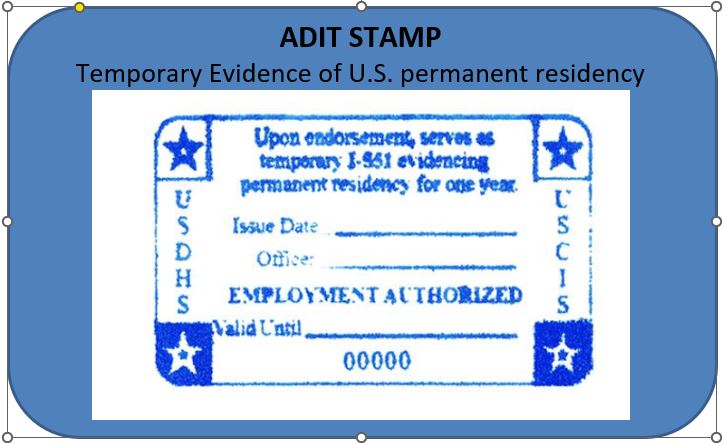
On March 16, 2023, USCIS announced a new policy that allows temporary green card stamps to be sent to legal residents by mail.  The new policy will make it more convenient for legal residents to obtain proof of their legal status.  

Lawful permanent residents are entitled to evidence of status for employment and travel purposes.  However, sometimes they do not have in their possession the physical green card for various reasons.  For example, they may have lost or misplaced their green cards, or they may be waiting for their renewal (I-90) or permanent green cards (I-751) to be approved by USCIS.  In these situations, they will require temporary evidence of their status in the form of a stamp on their passport. This stamp is called an ADIT stamp. 

For many years, if one requires temporary proof of their status, they are required to make an appointment with a local USCIS office to request for an ADIT stamp.  Under the new policy, a legal resident may contact the USCIS Contact Center to request temporary evidence of status.  After an immigration officer verifies his identity, physical mailing address, and whether that address can receive UPS or FedEx express mail, the request will be sent to a local field office.   

The local field office will then decide if an in-person appointment is required.  If it is not required, an ADIT stamp can be sent to the applicant on a Form I-94 with a DHS seal and a printed photo of the applicant.  The local office will also have discretion to decide the validity period of the ADIT stamp, which is generally one year.  

According to USCIS, some legal residents will still need to appear in person at a USCIS field office to receive an ADIT stamp.  For examples, applicants who have urgent needs, do not have a useable photo in USCIS systems, or whose address or identity cannot be confirmed, will be required to attend an in-person appointment. 


(Immigration laws and policies change regularly.  If you have any questions regarding this article, please visit www.1visa1.com to schedule a legal consultation.)  


Thursday, February 2, 2023

Asylees / refugees may apply for Green Card sooner under new policy


USCIS today clarifies some technical requirements for asylees and refugees to apply for permanent resident status (Green Card) through Adjustment of Status.  The most important items include:

1) Starting 2/2/2023, asylees and refugees only need one year of physical presence in the U.S. at the time their I-485 adjustment application is adjudicated by USCIS.  One year of physical presence is not required when they submit the I-485 application.

2) Asylees and refugees who are otherwise subject to the INA Section 212(e) 2-year residence requirements under the J visa program are eligible to apply for adjustment of status under INA Section 209.  A waiver is not required. 

As a result of these changes, asylees and refugees should be able to apply for U.S. permanent residency and citizenship sooner and easier than before. 

(Immigration laws and policies change regularly.  If you have any questions regarding this article, please visit www.1visa1.com to schedule a legal consultation.)  


Monday, January 23, 2023

48-Month Extension for Conditional Green Card Holders


Conditional residents who properly filed their extension applications will get 48 months of extension of their resident status, according to an announcement today by USCIS.  The filing receipt and the expired Green Card will serve as evidence of the extension.  The effective dates are as follows:

Conditional residents based on marriage: Starting 01/25/2023, the filing receipt of a properly filed Form 751 will contain language extending their green cards for 48 months.

Conditional residents based on investment:  Starting 01/11/2023, the filing receipt of a properly filed Form I-829 will contain language extending their green cards for 48 months.

USCIS will also issue new receipt notices to eligible conditional residents who have already filed their I-751 and I-829 applications. 


(Immigration laws and policies change regularly.  If you have any questions regarding this article, please visit www.1visa1.com to schedule a legal consultation.)  


Friday, December 9, 2022

Automatic Extension of Green Card After Filing for Naturalization


If your green card is expiring soon, applying for naturalization can save you the trouble of extending your green card.  Effective 12/12/2022, USCIS will automatically extend the validity of green cards for legal residents who have properly submitted an N-400 Application for Naturalization. 

Generally, U.S. legal residents are required to file an application (Form I-90) to extend their green cards within 6 months before expiration.  When a legal resident is also eligible for naturalization, she may also submit the N-400 application to apply for U.S. citizenship.  For many years, USCIS has an informal policy that allows legal residents to bypass the I-90 application if they have submitted an application for naturalization within six months of the green card's expiration.  However, without proper proof of legal status, legal residents would encounter problems when they travel internationally or apply for jobs. They would have to make an appointment with a local USCIS office to request for a temporary green card "ADIT" stamp on their passport.

The new policy aims at resolving these issues by affirmatively extending legal residents' green cards when they have properly submitted the N-400 application.  Starting 12/12/2022, legal residents who properly file for naturalization will receive automatic extension of their green cards for up to 24 months. USCIS will update the language of the N-400 receipt notices to reflect this change.  These receipt notices can be presented with the expired green card as evidence of these applicants' eligibility to work and to travel. 


Thursday, September 29, 2022

Immigration Medical Report 60-Day Waiver Extended


All U.S. green card applicants must provide a properly completed Form I-693, Report of Medical Examination and Vaccination Record, signed and sealed by an authorized doctor.  The regulation requires that the report must be submitted to USCIS within 60 days of the doctor's signature.  Due to COVID-19 and USCIS intention to ease case processing delays, the 60-day rule was waived temporarily until 09/30/2022.  Today, USCIS announced that the waiver will be extended to March 31, 2023.  It means that, from now until March 31, 2023, applicants may submit medical reports with a doctor's signature older than 60 days.  All other requirements must still be met. 

(Immigration laws and policies change regularly.  If you have any questions regarding this article, please visit www.1visa1.com to schedule a legal consultation.)  


USCIS Offers Two-Year Automatic Green Card Extension


Have you been waiting for your renewal green card? U.S. permanent residents must renew their green cards every ten (10) years by filing the Form I-90 with USCIS.  USCIS generally issues a receipt notice, which also serves as a one-year automatic extension of the applicant's green card. However, the current processing time for this application is unusually long.  Many cases are taking more than one year to process. Hence, effective 09/26/2022, USCIS is extending the automatic extension period to two (2) years.  The extension will be reflected in the updated I-797 receipt notices.  We recommend residents to file their green card extensions six months before expiration to ensure timely renewal. 


(Immigration laws and policies change regularly.  If you have any questions regarding this article, please visit www.1visa1.com to schedule a legal consultation.) 


Tuesday, May 10, 2022

Lover's Green Card: K-1 Fiancé(e) Visa or Immigrant Visa


When a U.S. citizen falls in love with an overseas foreign national, there are two ways to bring him/her to the United States as legal resident to live together.  One way is to apply for a fiancé(e) visa (K-1 visa) for the foreign national.  The other way is to petition for an immigrant visa on his/her behalf.  There are pros and cons to both options.  (Note: The following discussion assumes the foreign national is living in an overseas country. For foreign spouses who are residing in the United States, they may be able to apply for a green card through the process of Adjustment of Status.)


K-1 Fiancé(e)Visa

The K-1 fiancé(e) visa is technically a non-immigrant visa, as it does not confer permanent resident status to the holder.  However, in reality, it works more like a hybrid visa with features of an immigrant visa.  

To apply for a K-1 visa, the parties must not be married, but they must be able to legally marry each other. Further, they must have met at least once in person within the past two years, unless they are eligible for an exemption.  For example, some cultures or religions do not allow the couple to meet each other before their marriage.   Or if the couple can prove that it would be extremely difficult for them to meet due to financial or health reasons, they may also request for exemption. 

The application process starts with the I-129F application, which is used to establish the relationship of the couple.  Evidence of their relationship and eligibility to get married must be submitted.  Further, documents to prove that they have met each other in-person must also be provided. These include photographs, travel documents, hotel reservations, visa stamps, etc.   If the U.S. citizen has a criminal record, documents must also be submitted to USCIS to explain what happened.  

Upon approval of the I-129F petition, the case will pass through the National Visa Center before it is sent to the American Embassy or Consulate where the fiancé(e) is located.  An interview will be conducted to confirm the couple's relationship.  Note, the visa officer may not be convinced that the relationship is genuine, and K-1 visa rejections are common.

Assuming a K-1 visa has been issued, the foreign national may then enter the U.S. with it.  Upon arriving in the United States, the couple must get married within 90 days.  There is no exception to this requirement.  After their legal marriage, the foreign spouse may then apply for a green card through the process of Adjustment of Status.  The foreign spouse may stay in the U.S. until the green card is approved.  During this period, she may also apply for work authorization to work legally.  Another interview could be scheduled for the couple at a local USCIS officer before the green card can be approved. 


Immigrant Visa Petition

If the couple have already been married, the foreign spouse should directly apply for an immigrant visa.  Where they get married is not important, as long as the marriage is considered legal according to the local laws.  

First, the couple would file an I-130 Petition for Alien Relative with USCIS.  This petition is again to establish their marital relationship. Documents should be submitted to explain and prove their relationship.  For examples, how they met and how the relationship developed, etc. They must also prove that their marriage was lawful.  If they have been married before, they must provide legal documents to prove that the previous marriage was legally terminated. 

Upon approval of the I-130 petition, the case will be sent to the National Visa Center (NVC).  The foreign spouse must submit a comprehensive visa application called DS-260 with NVC, providing information about his or her background, family, education, work history, previous travel history, social media information, etc.  

Financial documents, such as income tax returns, to prove that the U.S. citizen can support the foreign spouse must also be submitted with the Form I-864, Affidavit of Support.  NVC processing has become lengthy and onerous in recent years.  Special care must be taken when preparing NVC documents.

Assuming NVC is satisfied with the documents, the case will then be forwarded to the American Embassy or Consulate where the foreign spouse is located.  As in the case of K-1, a visa interview will then be scheduled.  Only the foreign spouse needs to attend.  Questions will be asked about the couple's relationship.  An immigrant visa will be issued to the foreign spouse if he or she is found to be eligible to immigrate.  There are two types of immigrant visa, IR1 and CR1.  If the couple have been married for less than two years, then a CR1 visa will be issued.  CR1 is conditional for two years only; it means that after about two years, the couple must file another petition to remove the conditions.  Either way, the foreign spouse may then travel with the visa to the U.S. as a landing immigrant.  An actual green card will be mailed to the couple's address.

There is a variation of this method.  If the foreign national happens to be legally present in the U.S., he or she may be able to apply for a green card through Adjustment of Status directly without departing the U.S.


Conclusion

When it comes to applying for a marriage green card, there are different approaches.  Which way is more appropriate depends on the couple's particular situation and circumstances.  Immigration processing time has gotten longer due to the pandemic and staffing issues.  It is important to plan ahead of time to avoid unnecessary delays. 


(Immigration laws and policies change regularly.  If you have any questions regarding this article, please visit www.1visa1.com to schedule a legal consultation.)