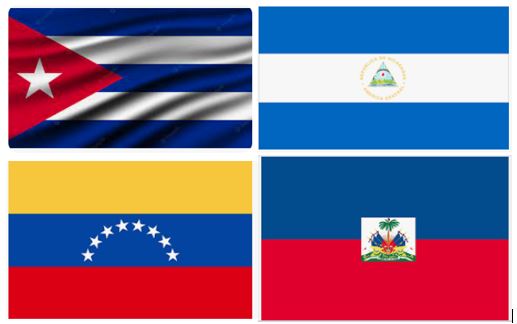
The U.S. Department of Homeland Security (DHS) announced a process for certain qualified Cubans, Haitians, and Nicaraguans to enter the United States legally as parolees. After entry by air, these individuals will be eligible to stay temporarily and work legally in the country. DHS also eliminated a numerical cap for a similar process for Venezuelans announced previously.
Basic RequirementsUnder this program, nationals from Cuba, Haiti, Nicaragua, and Venezuela will be granted advanced authorization to enter the U.S. if they meet the legal requirements, including the following three:
1) They must have a U.S. supporter who will promise to provide them with financial and other support;
2) They must undergo and clear a robust security vetting process; and
3) Deserve a favorable exercise of discretion based on humanitarian reasons or other public interest benefits.
Applicant Eligibility
An eligible applicant under this program must:
- Be outside the United States;
- Be a national of Cuba, Haiti, Nicaragua, or Venezuela; or be an immediate family member (spouse, common-law partner, and/or unmarried child under the age of 21) who is traveling with an eligible Cuban, Haitian, Nicaraguan, or Venezuelan;
- Have a U.S.-based supporter who filed a Form I-134A on their behalf that USCIS has vetted and confirmed;
- Possess an unexpired passport valid for international travel;
- Provide for their own commercial travel to an air U.S. POE and final U.S. destination;
- Undergo and pass required national security and public safety vetting;
- Comply with all additional requirements, including vaccination requirements and other public health guidelines; and
- Demonstrate that a grant of parole is warranted based on significant public benefit or urgent humanitarian reasons, and that a favorable exercise of discretion is otherwise merited.
A person is ineligible for parole if the person:
- Is a national or permanent resident of, or holds refugee status in, another country, unless he/she is an immediate family members (spouse, common-law partner, or unmarried child under the age of 21) of an eligible national of Cuba, Haiti, Nicaragua, or Venezuela with whom they are traveling.
- Fails to pass national security and public safety vetting or is otherwise deemed not to merit a favorable exercise of discretion;
- Has been ordered removed from the United States within the prior five years or is subject to a bar to inadmissibility based on a prior removal order;
- Has crossed irregularly into the United States, between the POEs, after the date the process was announced, except individuals permitted a single instance of voluntary departure or withdrawal of their application for admission.
- Has irregularly crossed the Mexican or Panamanian border after the date the process was announced; or
- Is under 18 and not traveling through this process accompanied by a parent or legal guardian, and as such is a child whom the inspecting officer would determine to be an unaccompanied child.
Who can be a U.S. sponsor?
Almost anybody who is legally residing in the U.S. and willing to provide financial and other support can be a sponsor, including: U.S. citizens and residents, refugees, asylees, temporary workers and visitors, individuals granted TPS, DACA and DED statuses.
A sponsor must pass security and background vetting and demonstrated sufficient financial resources to receive, maintain, and support the individual(s) whom they commit to supporting for the duration of their stay in the United States. They must provide supporting documents such as bank statements, employment and income verification, income tax return transcripts, etc. Several sponsors can join their efforts to sponsor one beneficiary. Organizations and other business entities may also provide additional support.
Basic Applicant Process
Step 1: U.S. Sponsor to Confirm Financial Support
A U.S.-based supporter will submit a Form I-134A, Online Request to be a Supporter and Declaration of Financial Support, with USCIS, for each beneficiary. USCIS will first confirm that the supporter is financially capable of sponsoring the beneficiary.
Step 2: Beneficiary to Submit Biographic Information
Upon receipt of an email notification from USCIS, the beneficiary must confirm their biographic information in myUSCIS and attest to meeting the eligibility requirements including public health requirements, and certain vaccination requirements.
Step 3: Beneficiary to Submit Request in CBP One Mobile Application
After his/her biographic information has been confirmed, the beneficiary will receive instructions through myUSCIS on how to access the CBP One mobile application. The beneficiary must enter their biographic information into CBP One and provide a photo.
Step 4: Advance Travel Authorization to the United States
Next, the beneficiary will receive a notice in their online account confirming whether CBP will, in its discretion, provide them with advance authorization to travel to the United States to seek a discretionary grant of parole on a case-by-case basis.
Step 5: Approval and Planning Air Travel to the United States
Upon approval by CBP, the beneficiary will be given authorization to travel to the U.S. within 90 days. Beneficiaries must purchase their own travel tickets to fly by air to the United States.
Step 6: Seeking Parole at the Port of Entry
When beneficiaries from these countries arrive in a port of entry, they will still have to go through additional screening and vetting, including additional fingerprint biometric vetting as part of the CBP inspection process. Finally, CBP will inspect them again and grant discretionary parole on a case-by-case basis. Parole will be granted for up to two years of duration.
Conclusion
This new process for granting advanced parole to Cubans, Haitians, Nicaraguans, and Venezuelans is good news for the needy citizens of these countries. Once approved, parole status can be extended and employment authorization will also be granted. Eligible individuals should apply as soon as possible. The application process and requirements are complicated. Sponsors and beneficiaries should seek legal assistance if they have any questions regarding the application process.